
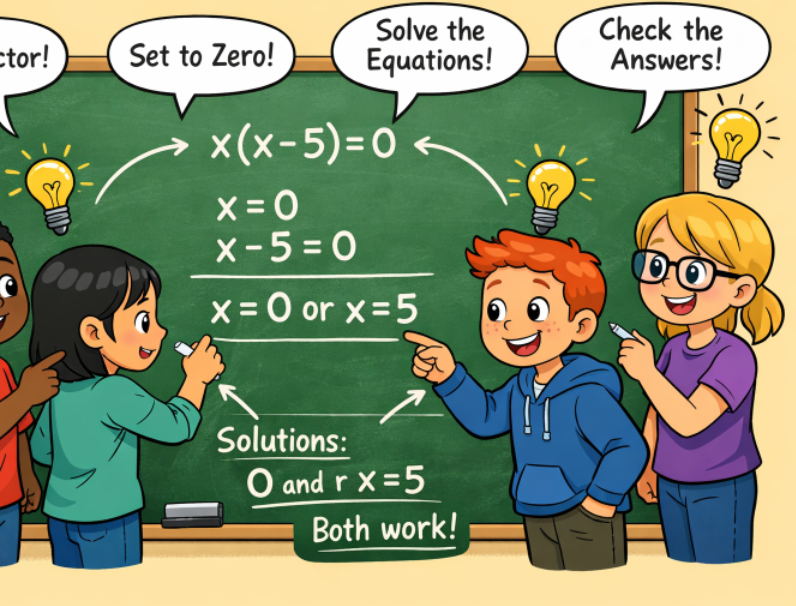
Mathematics is more than a sequence of calculations or memorized formulas. It operates as a bridge to critical thinking, analytical reasoning, and effective problem-solving, abilities essential across professional landscapes. Students pursuing a secondary education mathematics degree not only gain specialized knowledge but also develop skills to inspire and mentor the next generation of problem solvers.
Creating a robust mathematical foundation impacts a learner’s journey far beyond the classroom. Whether in technology, engineering, finance, psychology, or everyday problem-solving, math education shapes individuals to become resilient, analytical, and innovative thinkers, ready to take on evolving challenges and leadership responsibilities in a fast-paced world.
The Link Between Math and Leadership
High-quality math education equips students with competencies central to effective leadership. Problem-solving, analytical reasoning, and perseverance learned through mathematics mirror the skills needed to guide teams and navigate complex organizational obstacles. Mathematical challenges require decision-making based on logic and available data, similar to the methodologies utilized by influential leaders in business, science, and government. As students master these abilities, they prepare themselves to handle critical situations outside of academic settings with confidence and clarity.
Furthermore, mathematical thinking fosters clear and structured communication, which is a hallmark of strong leadership. When explaining complex concepts to peers or team members, individuals trained in mathematical reasoning can break down problems into smaller, digestible parts, a skill valued across all professions. As leaders, former mathematics students often exhibit decisiveness, objectivity, and adaptability, having honed their ability to evaluate options, anticipate outcomes, and guide others through processes requiring logical progression. This background positions them to thrive in roles that demand both vision and analytical rigor.
Mathematics as a Catalyst for Critical Thinking
Engaging deeply with mathematical concepts builds the neural pathways necessary for logical reasoning and independent judgment. Research published by Edutopia demonstrates that students who wrestle with complex mathematical problems and utilize process-oriented strategies show increased intellectual agility. This kind of thinking extends well beyond math class, resulting in problem solvers who are adaptable and capable of confronting new and unfamiliar issues with innovative perspectives and rational approaches.
Mathematics also provides structured problem-solving experiences that support metacognition, the awareness and regulation of one’s own thinking process. Students learn to identify assumptions, examine logical connections, and evaluate the validity of different approaches. Over time, they become adept at identifying errors, recalibrating their strategies, and persevering through setbacks. These skills build not only mathematical fluency but also resilience and open-mindedness, which are key elements in critical thinking and lifelong learning.
Real-World Applications Enhancing Analytical Skills
Contextualizing math lessons in real-world settings makes the subject more engaging and directly relevant to students. Career-connected instruction, which links mathematical content to authentic experiences in fields like data science or engineering, heightens students’ interest and deepens comprehension. According to a report by Education Week, when students encounter practical scenarios, whether budgeting in economics class or modeling data in science, they internalize how math applies to daily problems and professional success.
Moreover, projects involving statistical analysis, coding, or mathematical modeling expose students to tools and methodologies now commonplace in the modern workforce. By working collaboratively on these tasks, students gain experience in teamwork, communication, and applying mathematical reasoning to tangible challenges. This experiential learning fosters confidence and provides a clearer sense of purpose, making the transition from classroom to career much smoother. Math education that includes case studies, project-based work, and simulations prepares students to analyze data, generate solutions, and justify their conclusions in settings that mirror real professional demands.
Inquiry-Based Learning for Deeper Understanding
Inquiry-based learning shifts focus from rote memorization to active exploration, curiosity, and hypothesis-testing. This student-driven approach encourages learners to ask questions, propose solutions, and collaboratively test ideas, cultivating a healthy skepticism and depth of understanding. Barriers such as overly prescriptive curricula or limited instructional time can impede the adoption of this model, but reform efforts and support for professional development are gradually enabling broader implementation and improved student engagement.
Educators facilitating inquiry-based learning foster a culture of questioning, allowing students to connect mathematical theory with observations and real-life data. These environments help learners develop independence and responsibility for their learning. The ongoing conversation between teacher and student builds trust and respect for diverse methods of problem-solving, an asset in any discipline. As inquiry-based strategies gain momentum, educational outcomes improve, and mathematics becomes more accessible for all students.
Integrating Technology to Enhance Math Instruction
The rapid evolution of technology in education unlocks new opportunities for students to experience math in immersive, interactive ways. Platforms that use artificial intelligence, adaptive learning, and dynamic simulations engage students at their individual levels and adapt to their pace. Tools like virtual manipulatives and graphical simulations help visualize otherwise abstract concepts. These advancements make math accessible and compelling, while also supporting educators in addressing diverse learning needs and styles. For more insights on this trend, the Edutopia article on AI in math classrooms offers an in-depth exploration.
Educational technology also empowers students to explore mathematical ideas outside of traditional classroom hours, promoting self-directed learning. Video tutorials, interactive problem sets, and math games can reinforce lessons, while data-driven feedback helps teachers tailor their instruction. Digital platforms promote collaboration and knowledge sharing, breaking down physical barriers and making advanced content available to wider audiences. The growing integration of technology in mathematics education serves as a bridge to the digital skills needed in today’s and tomorrow’s workplace.
Future Directions in Mathematics Education
The future of mathematics education will rely heavily on personalizing instruction to meet each student’s unique strengths and challenges. Adaptive platforms and online resources are increasingly available, enabling students to progress at their own pace, revisit challenging concepts, and receive targeted feedback. Project-based learning, which simulates the complexity of modern careers, is also gaining traction as a strategy to help students transfer mathematical problem-solving to new and evolving contexts. As educators and administrators continue to explore best practices and emerging tools, the possibilities for developing future-ready problem solvers through math education continue to expand.
Continuous professional learning for educators is crucial as well. Teachers must stay current with evolving pedagogies, cultural competencies, and technology skills to engage diverse learners. By fostering partnerships with STEM professionals and community organizations, schools can design programs that inspire students through guest lectures, internships, and real-life project opportunities. This collaborative approach not only demystifies advanced mathematics but also helps to address equity gaps by providing access to resources and role models. As the boundaries between disciplines continue to blur and the world becomes more interconnected, mathematics education must remain dynamic and responsive, ready to equip students with the habits of mind and technical skills necessary to lead and innovate in any environment.
High-quality math education is a powerful engine for cultivating both the intellectual capabilities and the leadership qualities vital for tomorrow’s innovators, problem solvers, and change-makers. Focusing on skills development, practical application, and modern technologies ensures that students are well prepared to succeed and lead in a rapidly changing world.