
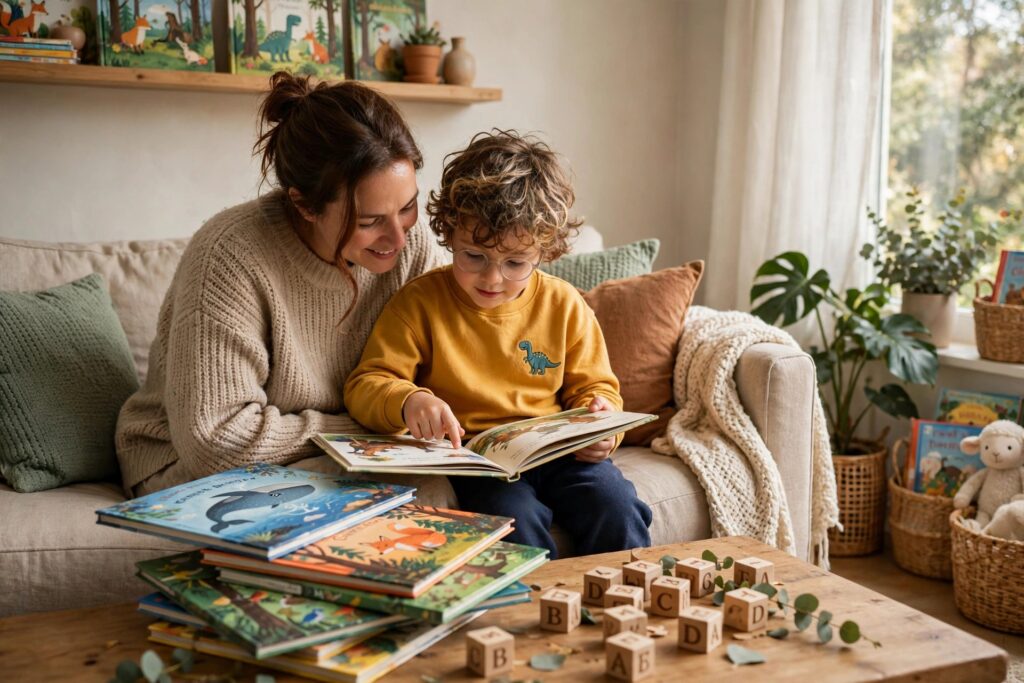
Teaching your child to read at home sounds like a big job, but it is really a series of small steps, done in the right order. You do not need a teaching degree, expensive programmes or hours of daily lessons. Most children learn to read with short, playful sessions of 10 to 20 minutes a day, plus a daily read-aloud habit.
This guide explains how to teach your child to read at home, step by step, in an order that matches how reading actually works. It is general information for parents, not a substitute for professional advice if your child has a diagnosed learning difficulty.
Step 1: Check Readiness First
Before any letters, check whether your child can hear the sounds inside words. This skill is called phonemic awareness, and it is the step most parents skip because it feels too simple. Try this quick check, as a game:
- Rhyme detection: “Does cat rhyme with hat? Does cat rhyme with dog?”
- First sound: “What is the first sound you hear in mum?” (The answer is “mmm”, not the letter name M.)
- Sound blending: Say “/c/ /a/ /t/” slowly, with pauses. Ask your child what word that makes.
- Sound segmenting: Say “fish”. Ask your child to say each sound: “/f/ /i/ /sh/”.
If your child manages three out of four, they are ready to start phonics. If not, spend a few weeks on sound games first — rhyming songs, clapping out syllables, and “I spy” with sounds (“I spy something beginning with /b/”). No letters yet. Children who start phonics before they can hear sounds usually struggle, while children who play sound games first often click with reading in weeks.
Step 2: Teach Letter Sounds, Not Letter Names
Start with a small set of sounds that make many short words: s, a, t, p, i, n. Teach the sound each letter makes, not its name. Say “sss” for s and “mmm” for m, and show the letter at the same time. Two to four new letters a week is plenty.
Keep it physical and fun. Trace big letters in sand or on a tray of flour, form them from play dough, or use magnetic letters on the fridge. Short, frequent practice beats long sessions: five minutes of letter play, several times a day, works better than one long lesson.
Step 3: Blend Sounds Into Words
As soon as your child knows three or four sounds, they can read real words. Point under each letter in “sat” and say its sounds slowly — /s/ /a/ /t/ — then run them together into “sat”. This is blending, and it is the heart of reading.
With the first six sounds (s, a, t, p, i, n), your child can already read words like sat, pin, tap, nip, pan and tin. That early success matters: a child who reads their first words feels like a reader, and that confidence carries them through the harder stages.
Step 4: Add Spelling and Simple Books
Reading and spelling strengthen each other. Say a word your child can read, such as “pin”, and ask them to say each sound and write a letter for it. Writing the words they read helps the spellings stick far better than memorising lists.
At the same time, give your child short books made only of the sounds they know — often called decodable books. A book full of words they cannot yet sound out is frustrating; a book built from known sounds is a win. Your local library usually stocks decodable readers, and many are cheap second-hand.
Step 5: Add New Patterns in Order
Once single-letter sounds are solid, add patterns in this rough order:
- Digraphs: sh, ch, th, ck, ng — two letters, one sound.
- Common sight words: the, of, to, was, said, you — words that do not follow the rules and need to be recognised at a glance. Teach about five to ten a week, through games like bingo or matching cards.
- Long vowels with silent e: cake, bike, hope, cute.
- Vowel teams: ai, ee, oa, ou, oi.
Do not rush. Each stage takes weeks, and that is normal. A child who spends a month on blending and reads confidently is ahead of a child pushed through three stages and guessing at every word.
Read Aloud Every Day
Alongside all of this, read aloud to your child every day. This is not optional extra — it builds vocabulary, sentence sense and a love of stories that phonics alone cannot give. Let your child choose the books, talk about the pictures, and ask what they think will happen next. Children who are read to regularly arrive at independent reading with a much bigger store of words to recognise.
For more ideas on keeping learning playful, see our guide to making learning engaging and fun for children.
Common Mistakes to Avoid
- Teaching letter names first. The name “cee” does not help a child read “cat”. Sounds come first.
- Memorising whole words as the main method. A memorised word helps with that one word. A letter sound helps with every word that contains it.
- Long lessons. Ten to twenty minutes a day is enough. A tired, bored child learns nothing.
- Correcting every mistake. If your child reads “dog” as “dug”, simply say the word correctly and move on. Constant correction kills confidence.
- Comparing with other children. Children start reading at different ages, usually between five and seven. A later start is not a problem if the steps are followed.
When to Get Extra Help
Most children learn to read with this approach, but some need extra support. If your child is still struggling to blend simple words after several months of regular practice, or if reading causes real distress, speak to their teacher or a reading specialist. Early help makes a big difference, and asking for it is not a failure — it is good parenting.
FAQ
What age should I start teaching my child to read?
Most children are ready between ages five and seven, when they can hear individual sounds in words. Age matters less than readiness: if your child can play the sound games in step one, they are ready, whatever their age.
How long does it take to teach a child to read at home?
With 10 to 20 minutes of daily practice, most children read simple books within three to six months of starting phonics. Full fluency takes longer — usually a year or more — and that is completely normal.
Should I buy a phonics programme?
You do not have to. The steps in this guide, plus decodable books from the library, are enough for most children. If you want structure, a simple, well-reviewed phonics workbook or app can help, but no programme replaces daily reading aloud and patient practice.
My child knows the alphabet song but cannot read. Is that normal?
Yes. Knowing letter names is different from knowing letter sounds, and sounds are what reading uses. Start with sounds, as in step two, and the alphabet song will still be useful later for spelling.
Conclusion
Teaching your child to read at home comes down to a clear order: sound games first, then letter sounds, then blending, then spelling and simple books, then new patterns one at a time — with daily reading aloud running alongside everything. Keep sessions short, keep them playful, and celebrate every small win. Your child does not need a perfect teacher. They need a patient one who shows up for ten minutes a day.